Showing posts with label adjectives. Show all posts

Saturday, March 16, 2024

Recognizing Sweeping Generalizations


person holding microphone person making speech


DEGREES OF COMPARISON

Adjectives have three degrees of comparison: 
Positive Degree - When describing one thing. (big tree)
Comparative Degree – When comparing two things.  (bigger tree)
Superlative Degree – When comparing more than two things. (biggest tree)
 
The superlative degree is created by adding est to some words or adding the word most. * 
For example: healthiest or most healthy
The brown one is the healthiest of the puppies.
The brown one is the most healthy of the puppies.
 
*Avoid double comparisons by using both est and most at the same time.
Wrong: The brown one is the most healthiest of the puppies.


RECOGNIZING SWEEPING GENERALIZATIONS


When using the superlative degree, it is important to avoid creating sweeping generalizations. When you add est or use the word most, it is easy to create a sweeping statement that goes too far in its description.


A sweeping generalization creates a statement that is too broad. 


Here are examples of sweeping generalizations:


Sweeping Generalization: Benjamin Franklin was the most brilliant of all inventors.

Better: Benjamin Franklin was one of the most brilliant of all inventors.


Sweeping Generalization: Joe Montana is the greatest of all quarterbacks in football history.

Better: Joe Montana is one of the greatest quarterbacks in football history.


It's important not to get carried away with the superlative degree and say way more than you intended to say. Use qualifying words such as frequently, most, some, a few, many, sometimes, often, or occasionally to make the superlative degree more acceptable.


Include the word “other” when comparing one thing with a group of which it is a part.


Statement: After WWII, the United States was stronger than any country in the world.

Better: After WWII, the United States was stronger than any other country in the world.


Politicians frequently use sweeping generalizations to appeal to emotions rather than facts. Be sure to examine all political statements for accuracy. 


Here are some examples from various media sources:

·      “All politicians are corrupt.”

·      “Immigrants are taking all our jobs.”

·      “Government is always inefficient.”

·      “All rich people are greedy.”

·      “All members of a certain political party are extremists.”

·      “All millennials are lazy and entitled.”

·      “Conservatives hate progress.”

·      “Liberals are all entitled and can't handle opposing views.”

·      “All corporations are evil.”


Be aware of using sweeping generalizations in your own writing and speech. Also, be an informed reader and listener and take note when a sweeping generalization is used in print or in speeches.


Adjectives and Adverbs can be powerful words. If you want to learn more about them and practice their use, I have several resources in my TPT store. You will find them here.


You will find a free worksheet here that helps students recognize and correct sweeping generalizations. As we enter the volatile climate of this political year, your students will benefit from being able to spot overgeneralizations that can lead to faulty conclusions.  


Thanks for reading. You may enjoy reading the interesting blog posts below from my friends in The Best of Teacher Entrepreneurs Marketing Cooperative. 


You are invited to the Inlinkz link party!

Click here to enter

Sunday, April 16, 2023

Eight Common Usage Mistakes


This is an example of a misplaced modifier that creates a humorous image. Was it the man who has leather seats?

We all make mistakes, and I am certainly not the Internet Police, but after seeing these bloopers online on social media, I thought these 8 common usage mistakes would make a good topic for a post. Here are just a few of some common errors I recently saw on Facebook and Twitter and a little information on how to avoid them.


1.  The dog's were all barking.
Do not use an apostrophe to make a noun plural.
Correction: The dogs were all barking.

 2.  "The puppy has a microchip in case she might loose her collar."
Loose means not tight.  Lose means to misplace.
Correction: The puppy has a microchip in case she might lose her collar.

3.  "I laid down for 5 minutes and woke up 2 hours later."
Laid means to put or to place something.
Correction: I lay down for 5 minutes and woke up 2 hours later.

4.  “I think that Mom's who watch soap operas are way two dramatic.”
There are two errors in this sentence.
1.  Do not use an apostrophe to make a noun plural.
2.  The word two means the number 2. The word too means to an excessive degree.
Correction: I think that moms who watch soap operas are way too dramatic.

5.  “I was just laying around feeling sick all week.”
The past progressive form of the verb “lie” is was lying. “Laying” means to put or to place.
Correction: I was just lying around feeling sick all week.


6.  “George is a very healthful person.”
Healthy and healthful are adjectives that can be used as synonyms for each other unless one is talking about a person. Spinach can be a healthy or a healthful vegetable, but when talking about a person, always use “healthy.”
Correction: George is a very healthy person.


7.  "I feel badly for you."
Badly is an adverb and will not follow a linking verb
Correction: "I feel bad for you."

Remember to not use badly with the verb "feel." If you say"I feel badly," you are really saying that your sense of touch is poor. (Maybe something is wrong with your fingers if you feel badly.) 


8.  "The woman that stood on the corner was tall."
Use "who" not "which" or "that" to refer to people unless you are referring to a group.
Correction: The woman who stood on the corner was tall.


Here are two free resources you can use to give your students practice with possessive nouns and confusing words.


If you would like to help your students practice correcting misplaced modifiers, this is a resource for sale in my store.


Here are some blog posts written by my teacher friends from The Best of Teacherpreneurs Marketing Cooperative. I think you will find them interesting and helpful.

Thanks for reading,
Charlene

You are invited to the Inlinkz link party!

Saturday, April 6, 2019

I Feel Bad for People Who Say They Feel Badly


Sometimes, even people who try to speak and write correctly end up making errors. I know I am guilty of that. Often those errors occur when people try to decide between the adjective “bad” and the adverb “badly.”


Here's a quick explanation that may help.
Be careful when using the words bad and badly,” so you will say exactly what you mean.

Most of the time, the choice is easy. 
For example: He has a bad cold. 
(Bad is an adjective that describes what kind of cold he has.) 
He behaved badly. 
(Badly is an adverb that describes how he behaved.)

The problem usually occurs when the word follows a linking verb, especially the linking verbs “feel” and “look.” (Remember that adjectives, not adverbs, should follow a linking verb.)


  • I feel badly. (This means my sense of touch is poor.) 
  • I feel bad. (This means my emotions are sad, unpleasant, or I am ill.) 

  • Jon looks bad. (This means he may be ill, or his appearance may be less than attractive.) 
  • Jon looks badly. (This means Jon has trouble with his vision.) 


Don’t feel bad if you have been making this mistake in your writing or speaking. The President of the United States and two famous television talk show hosts frequently use these words incorrectly. On one of the programs, the host said, “No one can make you feel badly about yourself except you.” I had a mental image of fingers moving around in the air.


The best way to avoid this mistake is to be conscious of the fact that you are using any form of the verb “feel” (feels, felt, feeling) or any form of the verb “look (looks, looked, looking), and then choose the correct word. 
              

If you need help with grammar or usage, be sure to check out my Simple Steps to Sentence Sense series of books. They have everything you need to become a better writer and speaker.

Thanks for reading,


Here are some interesting blog posts that you may find helpful.


You are invited to the Inlinkz link party!

Click here to enter

Tuesday, February 5, 2019

How to Choose Between Eager or Anxious


Before choosing between the words "eager" and "anxious," decide exactly what you mean to say. 


“Eager” means excited, interested, or impatient.
“Anxious” means afraid or nervous about what may happen.


Note the correct words in the sentences below:
Jane felt (eager, anxious) about the math test because she had not studied for it.
The bride and groom were (eager, anxious) to say their vows.


Now you try it:
The puppy was (eager, anxious) to please his master.
The patient was (eager, anxious) to hear the doctor’s report.


These words are often used interchangeably, but they should not be. They are not the same. Take the time to say what you really mean.


Visit my TpT store for more helpful tips and lessons.


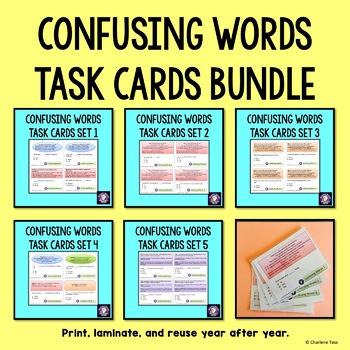
Here's a bundle of task cards to help your students master more confusing words. You will find them here.

Confusing Words Task Cards Bundle 1


This post is an update from a previous post.


Thanks for reading,


Inlinkz Link Party