Showing posts with label Tess's tips on grammar and usage. Show all posts

Sunday, May 18, 2025

Reflecting on the School Year As a Writer and Reader


Reflecting on Incidents and Feelings

When students are in school, it’s hard to believe that they won’t remember everything about their lives when they are older. The truth is they will forget many interesting things. The human brain is wired to forget unused or ineffective brain connections to make room for new memories.


Help your students get into the habit of writing a letter to themselves at the end of each year to summarize the significant incidents and feelings they would like to remember later. They can go back and read it in the future. I promise you it will be a worthwhile experience for them and for you.


“Writing a Letter to Myself” is a FREE activity for the end of a calendar year or the school year. You can get your FREE resource here.


Reflecting on Literature Read During the Year


The analysis of literature is a higher-order thinking skill that all students will be called upon to master from middle school through college in language arts classes. After reading a short story, novel, poem, or play, students will benefit from learning how to write about what they liked or disliked about the literary piece, discuss its literary elements, and decide what makes it unique. 


Students can reflect on the literature they most enjoyed or disliked and explain their reasons. Assignments such as these will help the teacher when planning future assignments.


I have a bundle of writing about literature resources in your store. Each resource is available individually, but you will save 20% if you buy the bundle. All of the resources have been assigned to my own students. I never put a resource in the store that my students disliked.


This time-saving bundle includes:

  • Analyzing a Fictional Character Writing Activity
  • Archetypes in Literature Critical Essay Writing
  • Character Analysis Writing Exercise with Rubric
  • Comparing and Contrasting Two Short Stories
  • Guide to Understanding Any Novel
  • Pretty Darn Fast Poetry Analysis Technique
  • Reading Reaction Journal Writing Activity
  • Short Story Analysis with Study Questions
  • Short Story with Comprehension Questions
  • Tips to Write a Timed Critical Essay
  • Three Ways Authors Reveal Characters
  • Understanding the Meaning of Metaphors


I hope this gives you some ideas for helping your students reflect on their growth as writers and readers. Visit my store for more helpful resources.


Thanks for reading,

Check out the Linky Party below to find blog posts from my teacher friends at The Best of Teacher Entrepreneurs Marketing Cooperative. If you would like to join this group, click here.

You are invited to the Inlinkz link party!

Click here to enter

Monday, July 15, 2024

Common Grammar Pitfalls and How to Avoid them


Grammar is an often-dreaded subject that can turn a great essay into a confusing mess. But fear not! Mastering grammar is essential for clear communication, and with a few simple tips, you can elevate your writing game.

Common Grammar Pitfalls and How to Avoid Them

  • Subject-Verb Agreement: Even the best writers need help with this one. Make sure your verb matches your subject (singular or plural).
    • Example: The cat is playful. (singular)
    • Example: The cats are playful. (plural)
  • Comma Splices: Avoid joining two independent clauses with just a comma. Instead, use a period, semicolon, or coordinating conjunction (and, but, or, for, nor, yet, so).
    • Incorrect: I love to read, and I also enjoy writing.
    • Correct: I love to read; I also enjoy writing.
  • Pronoun Agreement: Make sure your pronouns agree with their antecedents (the nouns they refer to) in gender and number.
    • Example: Everyone should bring their own book. (incorrect)
    • Example: Everyone should bring his or her own book. (correct)

Tips for Improving Your Grammar

  • Read Widely: The more you read, the better your grammar will become. Pay attention to how authors construct their sentences and use punctuation.
  • Write Regularly: Practice makes perfect! The more you write, the more comfortable you'll become with grammar rules.
  • Use Online Resources: There are countless websites and apps that can help you improve your grammar.
  • Proofread Carefully: Always review your work for errors before submitting it.

Beyond the Basics: Style and Clarity

  • Vary Your Sentence Structure: Avoid choppy sentences by mixing short and long sentences.
  • Choose the Right Words: Use precise language to convey your meaning effectively.
  • Be Concise: Get to the point without unnecessary words.

Remember, grammar is a journey, not a destination. With consistent effort and attention to detail, you can become a confident and effective writer.


A note to the teacher — I have lesson plans, activities, practice exercises, quizzes, and videos in my store that address each of the tips above. I invite you to visit my store and choose the resources that will be helpful. Click here for a free resource in my store. 


Visit my store for more helpful resources.

Thanks for reading. Check out the Linky Party below to find blog posts from my teacher friends at The Best of Teacher Entrepreneurs Marketing Cooperative. If you would like to join this group, click here.


Sunday, September 19, 2021

Simple Steps to Organize Your Workday


One of the best gifts we can give ourselves is organizing our time and eliminating some of the stress that often comes with each new day. I call it, pressing the reset button. Today is done. Start over tomorrow with a plan. 


I always try to take a few minutes to prepare for the next day at the end of each workday. I make a list and prioritize the things that I hope to accomplish tomorrow. I find that if I have a focused plan, I can get things done without feeling anxious. 


I leave myself notes and place sticky notes on folders and books that I plan to use. Pressing the reset button can work for you, too. No matter how tired you are, take a few minutes before you leave your office or classroom to clean off your desk and tidy up your work area. Be sure that when you return, you will find a neat, organized space. 

This system will help you at home too. Take time each evening to prepare for the following day. The few extra minutes you take to prepare will save you so much stress and tension in the morning when you are pressed for time. 

Before you go to sleep each night, be sure you have planned for the following day. 
  • Decide what you will have for breakfast and put out the dishes and flatware you will use. 
  • If there won't be time for breakfast, take along an energy bar, a piece of fruit, or a yogurt. 
  • Prepare your lunch for the following day or decide where you will eat lunch. 
  • Choose what you will wear and lay out your clothes and your shoes. (Don't wait until the next morning to discover that one of your shoes is nowhere to be found. Been there! Done that!) 
  • Place your keys and work materials near the door. If there is something you might forget to take along, write yourself a sticky note and put it with your keys. 
  • Be sure the kitchen and bathroom are neat and tidy. 
Press the reset button each day before you leave work.

  • Tidy up and organize your desk and work areas at the end of each day. 
  • Prioritize a "to do" list or leave yourself sticky notes to help you get started the following day. 
  • Leave work at work whenever possible. It will be there tomorrow. (I am a writing teacher, and I know doing so is not realistic much of the time, but do it if you can.) 

It may take you a few moments at the end of each day to press the reset button, but the following morning you will be so happy you did. Then, you can start your day with far less stress and worry. 


It works for me! 


Why not try it, or use a similar system that you devise?


Here’s a link to a FREE printable daily planner and to-do list. Enjoy!


While you are in my store take a look at some of my resources that involve taking simple steps to success for your students. Sign up for my newsletter for more freebies and tips.


Below are blog posts from my teacher friends at The Best of Teacher Entrepreneurs Marketing Cooperative. I always learn something from reading their blog posts. Thanks for reading mine.

Best regards,
Charlene


You are invited to the Inlinkz link party!

Click here to enter

Saturday, March 9, 2019

6 Confusing Words to Master


Confusing words, Tess's Tips


Learning to master confusing words is an essential skill for all writers. If students learn to use them correctly, it will help them throughout their adult lives.


Dying – means that a living being is no longer alive. Dying is the present participle of the verb die. Examples: I am just dying to see your new car. The poor man is dying of a horrible disease.


Dyeing - means to change the color of something by using a dye.
Examples:  Mother is dyeing her hair brown to hide the gray hairs. Jane is dyeing her shoes to match her dress.


Weather – means changes in the atmospheric condition. Examples: We need to check the weather before we set sail. The weather is warm and dry today.

Whether – is used to indicate possibilities or choices.
Example: He was not sure whether or not to eat sushi.


Whether - also means if something is or was true.
Example: Will you find out whether or not they want to go with us to the movie?
HINT: When choosing between weather and whether, be sure to pronounce the “h” in whether. If you are talking about clouds, rain, and such, choose weather. There is no “h” sound in weather.


Advice – is a noun that means an opinion or suggestion that one gives to another.
Advise – is a verb that means to give an opinion or suggestion.


HINT: Try substituting the word feedback into the sentence. If it makes sense, choose the noun advice.
Example A: I need your (advice, advise) on how long my speech should be.
I need your (feedback) on how long my speech should be.
Since you could substitute the word feedback in this sentence, choose advice.


Example B:  You need to (advice, advise) me on how long my speech should be.
You need to (feedback) me on how long my speech should be.
Since you could not substitute the word feedback in this sentence, choose advise.


Click here for a free lesson and exercise on correctly using these 6 confusing words.


Be sure to visit my store for more free lessons and take a look at my Simple Steps to Sentence Sense books. Help your students learn grammar and usage the easy way.


This article is an update from an earlier post.


Thanks for reading,

Charlene Tess author of  Simple Steps to Sentence Sense


You are invited to the Inlinkz link party!
Click here to enter

Tuesday, February 5, 2019

How to Choose Between Eager or Anxious


Before choosing between the words "eager" and "anxious," decide exactly what you mean to say. 


“Eager” means excited, interested, or impatient.
“Anxious” means afraid or nervous about what may happen.


Note the correct words in the sentences below:
Jane felt (eager, anxious) about the math test because she had not studied for it.
The bride and groom were (eager, anxious) to say their vows.


Now you try it:
The puppy was (eager, anxious) to please his master.
The patient was (eager, anxious) to hear the doctor’s report.


These words are often used interchangeably, but they should not be. They are not the same. Take the time to say what you really mean.


Visit my TpT store for more helpful tips and lessons.


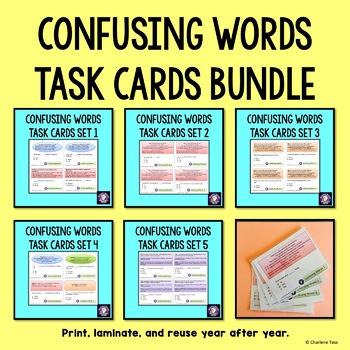
Here's a bundle of task cards to help your students master more confusing words. You will find them here.

Confusing Words Task Cards Bundle 1


This post is an update from a previous post.


Thanks for reading,


Inlinkz Link Party